
You're running ads, posting listings, maybe even getting inquiries. But somewhere between first click and signed contract, buyers disappear. The problem usually isn't your property or your price. It's the gap between attracting attention and converting it into a viewing.
A real estate marketing funnel closes that gap by guiding prospects through a structured path, from discovering your listing to booking a site visit to closing the deal. This guide breaks down each stage of the funnel, the tactics that work at every level, and the tools you can use to build a system that actually moves inventory.
What is a real estate marketing funnel
A real estate marketing funnel is an automated, step-by-step system that guides a cold stranger from discovering your brand to becoming a loyal, closed client. Picture it as a path: at the top, you attract people who might want to buy or sell property soon, and at the bottom, you convert the serious ones into signed deals.
Why does this matter? Most buyers aren't ready to purchase the moment they see your listing. A first-time buyer in Lekki might spend months researching neighborhoods before contacting an agent. A funnel keeps you visible throughout that journey, so when they're finally ready, you're the one they call.
The concept works whether you're a solo realtor, a developer with 200 units to move, or an agency managing listings across Lagos and Abuja. The tactics change depending on your inventory and budget, but the logic stays the same: attract, nurture, convert.
The four stages of a real estate marketing funnel
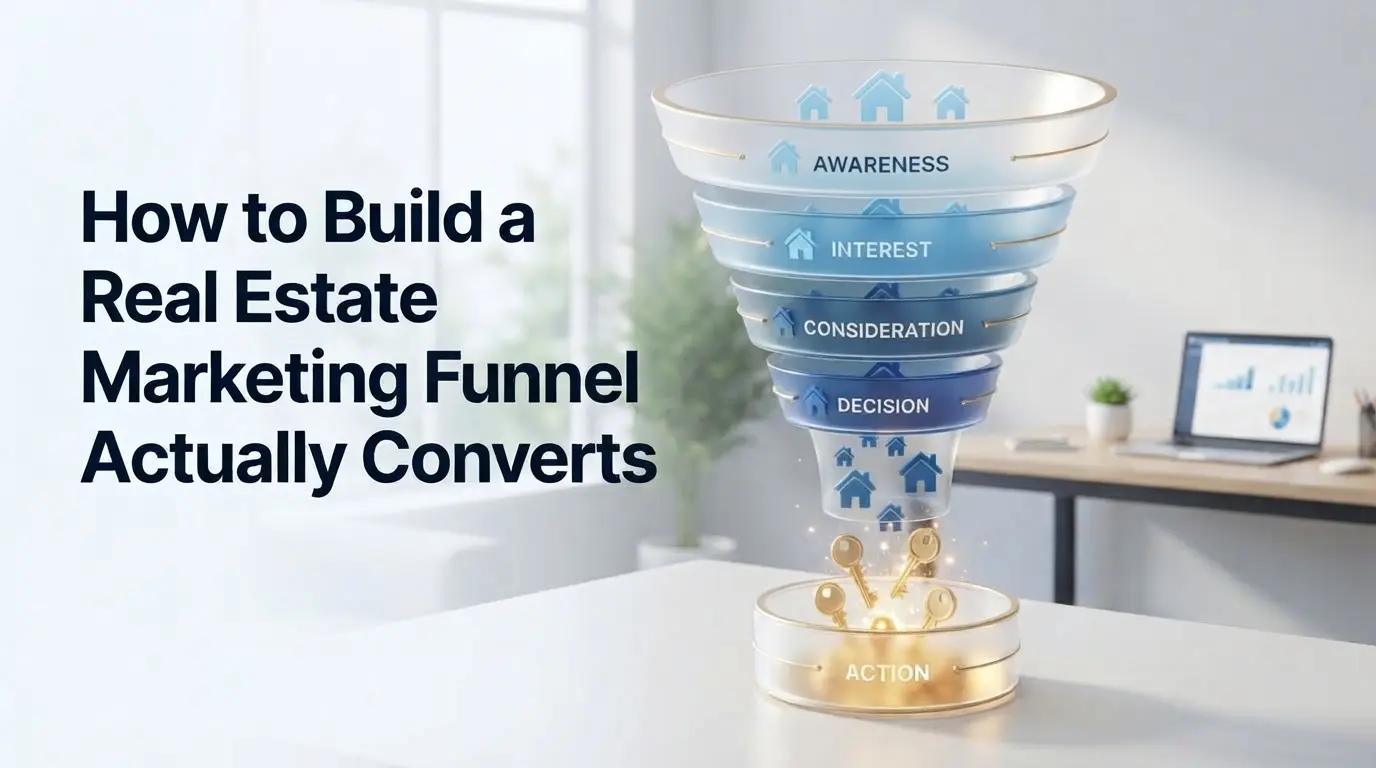
Most funnels follow the AIDA framework: Awareness, Interest, Decision, Action. Each stage calls for different content and different touchpoints. You can't close a buyer who doesn't know you exist, and you can't expect someone who just discovered your listing to book a viewing immediately.
Awareness
This is where a potential buyer first learns your property or development exists. They might see a Facebook ad, find your listing on Google, or stumble across your Instagram post. The goal here is reach: get in front of as many relevant people as possible.
At this stage, you're not asking for a commitment. You're offering something useful in exchange for attention, maybe a free neighborhood guide or a price list PDF. The buyer trades their email or phone number for your resource, and now you have a lead.
Interest
Once someone knows you exist, the next step is holding their attention. This is where they explore property details, scroll through photos, read about the neighborhood, or watch a virtual tour.
Your job here is to build desire. Show them what life looks like in that apartment in Ikoyi. Explain why the title documents are verified. Answer the questions they're already asking themselves.
Decision
Now the buyer is actively weighing options. They might request pricing, ask about payment plans, or schedule a call.
This is where you position your listing as the best fit. Address objections before they're raised. Offer a site visit. Make it easy to take the next step.
Action
The final stage is where the buyer books a viewing, makes an offer, or signs. Your goal is to remove friction: online booking tools, clear documentation, prompt follow-up. A slow response at this stage can lose a deal you've spent weeks nurturing.
How to build a real estate marketing funnel step by step
Step 1. Define your ideal buyer and inventory fit
Before you build anything, get clear on who the property suits. A three-bedroom flat in Ajah attracts a different buyer than a luxury penthouse in Banana Island. First-time buyers, investors, renters, and leisure seekers all have different motivations and budgets.
Segment your audience by location, budget, and property type. The more specific your targeting, the more relevant your messaging, and the higher your conversion rate.
Step 2. Design offers for each funnel stage
An "offer" here doesn't mean a discount. It means the thing you're giving the prospect at each stage in exchange for their attention or contact details.
- Awareness offer: A free resource like a neighborhood guide, price list, or investment calculator
- Interest offer: Deeper engagement such as a virtual tour, detailed brochure, or WhatsApp consultation
- Decision offer: A site visit, sales consultation, or personalized payment plan
Each offer moves the prospect one step closer to buying.
Step 3. Set up landing pages and verified listings
A landing page is a dedicated page designed to capture leads from a specific campaign. Unlike your homepage, it has one job: get the visitor to fill out a form or click a button.
Verified listings build trust, which matters in a market where buyers worry about title fraud. When a listing shows confirmed C of O or Governor's Consent, serious buyers feel safer reaching out. Platforms like Realinkr verify listings before they go live, which means agents receive inquiries from prospects who already trust what they're seeing.
Step 4. Launch paid traffic and retargeting
Paid ads on Facebook, Instagram, and Google drive cold traffic to your landing pages. You can target by location, age, income, and interests, so your ads reach people who can actually afford your inventory.
Retargeting re-engages visitors who left without converting. If someone viewed your listing but didn't inquire, a retargeting ad reminds them of the property a few days later.
Step 5. Automate follow-up and viewing bookings
Most leads don't convert on the first touch. An automated email or WhatsApp sequence nurtures them over time, sending new listings, market updates, or helpful content until they're ready to act.
Online booking tools let prospects schedule viewings instantly, without the back-and-forth of phone calls and texts. The easier you make it to book, the more viewings you'll get.
Top of funnel strategies to attract property buyers
SEO-ready property listings and neighborhood guides
When a buyer searches "3 bedroom flat Lekki Phase 1" on Google, you want your listing to appear. SEO-ready listings are optimized for the search terms buyers actually use, with clear titles, descriptions, and location tags.
Neighborhood guides capture location-based searches and position you as the local expert. A guide covering price ranges, schools, and infrastructure in Asokoro or VGC brings in organic traffic month after month, without ongoing ad spend.
Paid social and search ads for real estate
Facebook and Instagram work well for visual property ads. You can target by demographics and interests, showing a luxury apartment to high-income users in Lagos or a family home to married couples in Abuja.
Google Search ads target high-intent keywords like "buy house in Abuja" or "land for sale in Ibeju-Lekki." Buyers using search terms like that are actively looking, which often means they're closer to a decision.
Lead magnets like price lists and investment guides
A lead magnet is a free resource you offer in exchange for contact details. Examples include a development price list PDF, a "First-Time Buyer Guide," or an ROI calculator for investors.
The key is relevance. A diaspora buyer considering property in Nigeria wants different information than a local investor looking for rental yield. Match your lead magnet to your audience.
Middle of funnel tactics to nurture real estate leads
Email and WhatsApp nurture sequences
Once you have a lead's contact details, automated sequences keep you in front of them. A typical sequence might include a welcome message, followed by new listings, market updates, and helpful tips over the next few weeks.
WhatsApp is especially effective in African markets because open rates are high and the communication feels personal. Segment your list by budget or location so each message stays relevant.
3D property listings and virtual tours
Immersive tools let prospects explore properties remotely before visiting in person. A diaspora buyer in London can walk through a flat in Lekki without flying in. Virtual tours also reduce unqualified viewings, since buyers who've already "seen" the property online tend to be more serious when they show up.
Retargeting campaigns for high-intent buyers
Retargeting ads appear to people who visited your listings but didn't inquire. A reminder ad often pushes them to take the next step.
Set up a Facebook Pixel or Google Ads remarketing tag on your website to track visitors and serve them targeted ads later.
Bottom of funnel tactics that convert leads into buyers
Qualifying leads before a viewing
Not every inquiry deserves a site visit. Before scheduling, ask a few screening questions: What's your budget? Are you paying outright, mortgage, or installment? When do you want to move?
Leads with a clear budget and timeline are worth your time. Leads who can't answer those questions often aren't ready to buy.
Booking site visits and sales consultations
Online booking tools reduce the friction of scheduling. Instead of exchanging five WhatsApp messages to find a time, the prospect picks a slot from your calendar.
Site visits are where most deals are won or lost. Prepare by reviewing the lead's preferences, anticipating objections, and having documentation ready.
Closing with verified documentation and follow-up
Trust is everything in African real estate. Buyers worry about title fraud, incomplete documentation, and developers who disappear. Verified documents (C of O, survey plans, Governor's Consent) reduce anxiety and speed up decisions.
After a viewing, follow up within 24 hours. Address any objections raised during the visit. The longer you wait, the more likely the lead goes cold.
Tools and PropTech stack for a real estate sales funnel
| Tool Category | Purpose | Examples |
|---|---|---|
| CRM | Track leads and manage pipeline | HubSpot, Zoho, Pipedrive |
| Email Automation | Nurture sequences and drip campaigns | Mailchimp, Brevo, ActiveCampaign |
| Landing Page Builders | Capture leads from ads | Leadpages, Unbounce, Carrd |
| Analytics | Track funnel performance | Google Analytics, Meta Ads Manager |
| PropTech Platforms | Listings, virtual tours, lead capture | Realinkr, Matterport |
CRM and lead management platforms
A CRM (Customer Relationship Manager) stores every lead's contact info, tracks your interactions, and shows where each prospect sits in the funnel. Even a simple Google Sheet with columns for name, phone, budget, status, and next action can keep you organized.
Marketing automation and email tools
Automation handles repetitive tasks: welcome emails, follow-up sequences, viewing reminders. This frees you to focus on high-value conversations instead of manual outreach.
Analytics and attribution software
Track which channels produce leads and which produce sales. Attribution shows the path a buyer took before converting, so you know whether your Facebook ads or your SEO listings are doing the heavy lifting.
Metrics and KPIs to measure real estate funnel performance
Cost per lead and cost per qualified viewing
Cost per lead equals your ad spend divided by the number of leads generated. Cost per qualified viewing is more useful because it filters out tyre-kickers who never intended to buy.
Conversion rate by funnel stage
Track drop-off between stages: awareness to interest, interest to decision, decision to action. If 1,000 people see your ad but only 10 inquire, your awareness-to-interest conversion rate is 1%. Identifying where the funnel leaks tells you where to focus your optimization efforts.
Lead to deal ratio and sales cycle length
Lead to deal ratio shows how many leads it takes to close one sale. Sales cycle length is the average time from first contact to closed deal. Both metrics help you forecast revenue and plan your marketing spend.
Common mistakes that break a real estate marketing funnel
- No follow-up system: Leads go cold because no one responds within hours
- Mismatched targeting: Ads reach people who cannot afford the property
- Too much friction: Forms ask for excessive information, or booking requires phone calls
- Ignoring mobile: Most property searches in Africa happen on phones, so slow or broken mobile pages lose leads
Build a funnel that sells inventory faster with Realinkr
Realinkr combines verified listings, content marketing, and performance marketing into one platform built for the African real estate market. Developers and agents get SEO-ready listing pages, lead capture tools, and a network of verified agents. Buyers get properties with confirmed title documents and a step-by-step path to their next home.
Frequently asked questions about real estate marketing funnels
What is the 3-3-3 rule in real estate marketing?
The 3-3-3 rule suggests contacting a new lead within 3 minutes, following up 3 times, and using 3 different channels (phone, email, text) to maximize response rates. Speed and persistence matter because the first agent to respond often wins the client.
What are the 5 P's in real estate marketing?
The 5 P's are Product (the property), Price, Place (location and channels), Promotion (advertising and content), and People (agents, buyers, sellers involved in the transaction). The framework helps you think through every element of your marketing mix.
How long does a real estate marketing funnel take to produce results?
Most funnels require several weeks to generate consistent leads. The sales cycle for property often extends to months depending on price point and buyer readiness. Off-plan developments typically take longer because buyers need more nurturing before committing.
How much should a real estate agent budget for funnel advertising each month?
Budgets vary by market and inventory value. A common approach is to allocate a portion of expected commission per unit toward ads, then adjust based on cost per lead and conversion performance. Start small, measure results, and scale what works.
Do real estate marketing funnels work for off-plan developments?
Yes. Funnels suit off-plan sales well because buyers need more trust-building before committing to properties that don't yet exist physically. Virtual tours, progress updates, and developer credibility content all help move prospects through the funnel.
Deploy Algorithmic Buyer Acquisition on Your Portfolio
Accelerate sales velocity, reduce Cost Per Qualified Lead (CPL), and access verified high-net-worth buyers with Realinkr’s proven data infrastructure.

Syla Peter
VerifiedSpecializing in algorithmic buyer acquisition, institutional off-plan distribution, and conversion rate optimization (CRO) for residential and commercial development projects.