
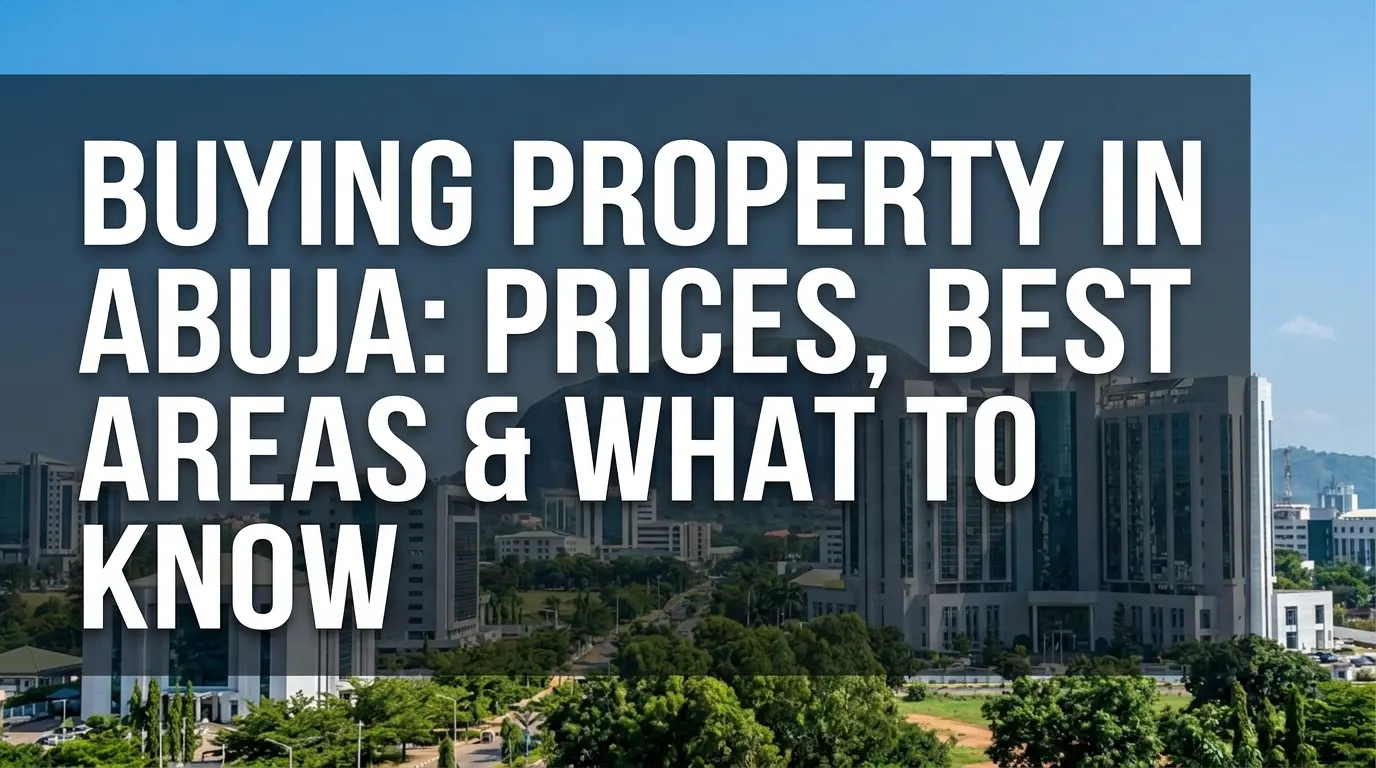
Abuja’s skyline is undergoing an unprecedented transformation. As Nigeria’s capital city, the Federal Capital Territory (FCT) has evolved from a quiet administrative hub into one of Africa’s most lucrative real estate frontiers. Heading into 2026, a mixture of rapid urbanization, aggressive infrastructural expansions such as the revitalization of the Abuja Light Rail and the dualization of major arterial roads and a growing class of high-net-worth investors have pushed Abuja’s property market into overdrive.
Whether you are a diaspora investor looking for a high-yield rental property, a local family seeking a secure gated estate, or a real estate professional leveraging tech tools like Realinkr, understanding the nuances of the FCT property landscape is critical to making profitable and legally secure decisions.
This ultimate guide breaks down everything you need to know about buying property in Abuja in 2026: from district prices and legal document verification to property taxes and emerging development corridors.
Why Buy in Abuja? (FCT Stability, Strong Rental Yield, Expat Demand)
Investing in Abuja’s real estate market offers a unique set of defensive and offensive financial advantages that few other African cities can match.
1. Master-Planned FCT Stability
Unlike the organic, often chaotic expansion of Lagos, Abuja was built according to a strict master plan. Designed in the late 1970s, the city features zoned residential, commercial, and green areas. While traffic congestion and infrastructural strain affect some outlying districts, the central districts boast superior drainage networks, wider paved roads, and organized utility layouts. This predictable urban planning translates directly to long-term property value appreciation.
2. High-Yielding Rental Market
Abuja’s rental market is highly lucrative, particularly due to the unique local practice of demanding one to two years of upfront rent. For investors, this provides immediate, significant cash flow.
- Short-let Apartments: Driven by local business travelers, politicians, and consultants, high-end short-lets in Wuse II, Maitama, and Garki yield upwards of 12% to 15% annually.
- Long-term Corporate Rentals: Corporate leases paid by multinationals, local blue-chip companies, and non-governmental organizations provide stable, long-term returns.
3. Diplomatic and Expat Demand
As the seat of international diplomacy in Nigeria, Abuja houses over 100 foreign embassies, high commissions, and international aid agencies. Expats and diplomatic staff demand premium, highly secure housing. Properties in "Diplomatic Zones" within Maitama, Katampe Extension, and Dakibiyu often command rents priced in US Dollars or premium Naira, shielding investors from local currency fluctuations.
Expert Insight:
"Abuja's real estate market in 2026 is no longer just about buying land and waiting. It has matured into an asset-class market where premium finishes, integrated smart home technology, and bulletproof security systems dictate the capitalization rates of residential investments."
Property Prices in Abuja by Area (2026)
Property values in Abuja vary significantly based on the developmental "Phases" established by the Federal Capital Development Authority (FCDA). Phase 1 represents the established inner-city core, while Phases 2, 3, and 4 represent progressive outward expansions.
Below is a comprehensive breakdown of average land prices per square meter and typical 3-bedroom terrace/house costs across key districts in 2026:
District | FCT Phase | Avg. Land Price (per Sqm) | Typical 3-Bed House Cost | Primary Investment Profile |
Maitama | Phase 1 | ₦950,000 – ₦1,500,000 | ₦450,000,000 – ₦800,000,000 | Ultra-luxury, diplomatic leases, prestige preservation |
Wuse II | Phase 1 | ₦800,000 – ₦1,200,000 | ₦350,000,000 – ₦600,000,000 | Premium residential-commercial mix, short-let goldmine |
Garki | Phase 1 | ₦600,000 – ₦850,000 | ₦220,000,000 – ₦380,000,000 | High-density corporate, stable executive residential rentals |
Gwarinpa | Phase 3 | ₦450,000 – ₦700,000 | ₦150,000,000 – ₦280,000,000 | Mature middle-class hub, vibrant commercial ecosystem |
Katampe | Phase 2 | ₦400,000 – ₦650,000 | ₦180,000,000 – ₦320,000,000 | High-end panoramic views, rapid luxury development |
Lugbe | Phase 5 / Corridor | ₦120,000 – ₦250,000 | ₦65,000,000 – ₦120,000,000 | High-growth commuter hub, affordable housing, airport road proximity |
Property Documents in the FCT: C of O vs. Right of Occupancy
One of the most critical aspects of buying property in Abuja is understanding the legal titles issued by the FCT administration. Navigating these documents correctly prevents costly legal battles and safeguards your asset.
Certificate of Occupancy (C of O)
The Certificate of Occupancy is the ultimate land title issued directly by the FCT Minister on behalf of the President of Nigeria. It serves as proof of ownership of a 99-year leasehold on the land. A C of O is registered in the central land registry, making it widely accepted by financial institutions as collateral for loans.
Right of Occupancy (R of O)
The Right of Occupancy (often referred to as an Allocation Letter or Offer of terms) is a precursor to the C of O. It is a document issued by the FCTA indicating that a specific parcel of land has been allocated to an individual or corporate entity under specific conditions (e.g., payment of premium, ground rent, and development timelines).
While an R of O is legally binding, it is conditional. To secure your investment fully, you must eventually convert your R of O into a registered C of O by fulfilling all financial and developmental obligations set by the FCDA.
Why This Matters for Property Tax & Ownership
Properties held under an R of O or C of O are subject to annual Ground Rent collected by the Abuja Geographic Information Systems (AGIS). Failing to pay these fees can lead to the revocation of the title by the FCT Minister. Furthermore, properties with clean, registered C of O documents command significantly higher resale values in the open market.
How to Verify Land Documents in Abuja (AGIS Checks)
Never buy land or completed buildings in Abuja based on trust, photocopies, or promises. The golden rule of FCT real estate is: Verify through AGIS before making any financial commitment.
The Step-by-Step AGIS Verification Process:
- Obtain Photocopies of Title Documents: Request the seller to provide clear copies of the Right of Occupancy (R of O), Certificate of Occupancy (C of O), or the Letter of Allocation, along with the approved building plan and site layout (TDP - Technical Data Sheet).
- Engage a Qualified Property Lawyer: A registered lawyer with experience in FCT land administration is essential to conduct the search on your behalf.
- Pay the Official Search Fee: Pay the prescribed search fee via the REMITA platform to the Abuja Geographic Information Systems (AGIS) account.
- Submit a Formal Search Application: Your lawyer will write an official letter to the Director of AGIS, attaching the payment receipt, copies of the land documents, and the consent letter signed by the current property owner authorizing the search.
- Review the AGIS Search Report: AGIS will issue an official Legal Search Report. This document reveals:
- The genuine registered owner of the property.
- Whether the property has been used as collateral for an outstanding bank mortgage.
- Any court disputes or government caveats registered against the plot.
- Whether the land is designated for residential, commercial, or public utility use (zoning verification).
Property Tax in the FCT (2026)
In 2026, the Federal Capital Territory Administration (FCTA) has digitalized and tightened property tax collections to boost internally generated revenue. Property owners must account for these recurring and transactional costs when calculating their Return on Investment (ROI).
Key FCT Property Taxes and Fees:
- Ground Rent: An annual tax paid to the FCTA by all holders of C of O or R of O documents. The amount is calculated based on the size of the land and the district classification (Phase 1 pays significantly more than Phase 3).
- Tenement Rates: Local government councils (such as the Abuja Municipal Area Council - AMAC) levy tenement rates on occupied properties. This fee is typically paid by the occupier (tenant) or landlord, depending on the lease agreement.
- Consent Fees and Registration Fees: When buying an existing property, you must pay a Governor's Consent Fee (usually 8% to 10% of the assessed property value) to legally transfer the title from the seller to your name.
For a detailed look at navigating tax obligations across Nigeria, read our extensive guide on [Property Taxes in Nigeria] .
Top Estates and New Developments in Abuja
If you want to bypass the stress of buying raw land and building from scratch, purchasing a home or serviced plot within a master-planned estate is the most secure route. Here are the top estates and investment corridors to watch in 2026:
1. Katampe (Main & Extension)
- Vibe: Highly exclusive, hilly terrain offering breathtaking views of the city.
- Development: Home to premium gated communities featuring underground cabling, central sewage treatment, and strict security protocol.
- Target Audience: Upper-middle class, executive families, and diaspora buyers.
2. Gwarinpa Estate
- Vibe: Established, busy, and highly commercialized.
- Development: As the largest single housing estate in West Africa, Gwarinpa is transitioning. While older bungalows are being bought and remodeled into luxury multi-family apartments, its commercial strips (such as 3rd and 4th Avenue) remain commercial goldmines.
3. Life Camp
- Vibe: Quiet, green, and highly secure.
- Development: Strategically located near the city center, Life Camp houses several diplomatic residences and high-profile government officials. Modern residential estates here offer high security and family-friendly amenities.
4. Karsana
- Vibe: Affordable premium, rapid growth.
- Development: Located along the Kubwa Expressway, Karsana is Phase 4's jewel. It features master-planned estate developments offering affordable luxury terraces and semi-detached duplexes at a fraction of central city prices.
5. The Airport Road Corridor (Lugbe & Kyami)
- Vibe: The gateway to Abuja, high commuter traffic.
- Development: Driven by proximity to the Nnamdi Azikiwe International Airport, this corridor is packed with smart-city estates. It is the premier location for mid-level professionals seeking affordable, modern housing with great transit access.
Working with a Real Estate Agent in Abuja
Abuja’s real estate market can be highly fragmented, with thousands of unlicensed agents operating across the capital. To protect your investment, always work with registered, tech-enabled real estate teams.
Why Smart Real Estate Teams Use Realinkr
In 2026, property transactions require speed and accuracy. Modern real estate developers and agencies in Abuja utilize Realinkr to streamline their processes.
- Instant Listing Access: Realinkr allows home seekers to quickly filter through verified, high-definition listings across Abuja's premium districts.
- Advanced Team Management & Lead Tracking: For real estate agencies operating in Abuja, Realinkr’s collaborative CRM allows teams to manage buyer inquiries instantly, track physical site-inspection schedules, and manage property portfolios efficiently.
- Verified Data: Realinkr connects serious buyers with vetted agents, reducing the risk of encountering fraudulent land listings.
Ready to Take Your Next Step in the Abuja Property Market?
Whether you are hunting for an ultra-luxury duplex in the hills of Katampe Extension, a rental cash-cow in Wuse II, or a starter family home along the rapid-growth Airport Road corridor, finding the right partner makes all the difference.
Take action today:
- [Browse Verified Properties in Abuja on Realinkr] to explore authentic, high-definition listings direct from trusted developers.
- Are you an Abuja-based real estate agent? Sign up on Realinkr to leverage professional lead tracking, speed up your listing time, and reach thousands of verified buyers in the diaspora.
Buying Property in Abuja in 2026: Prices, Best Areas & What to Know
The ultimate 2026 guide to buying property in Abuja. Discover land prices, district analysis, AGIS verification steps, FCT property taxes, and market trends.
Deploy Algorithmic Buyer Acquisition on Your Portfolio
Accelerate sales velocity, reduce Cost Per Qualified Lead (CPL), and access verified high-net-worth buyers with Realinkr’s proven data infrastructure.