
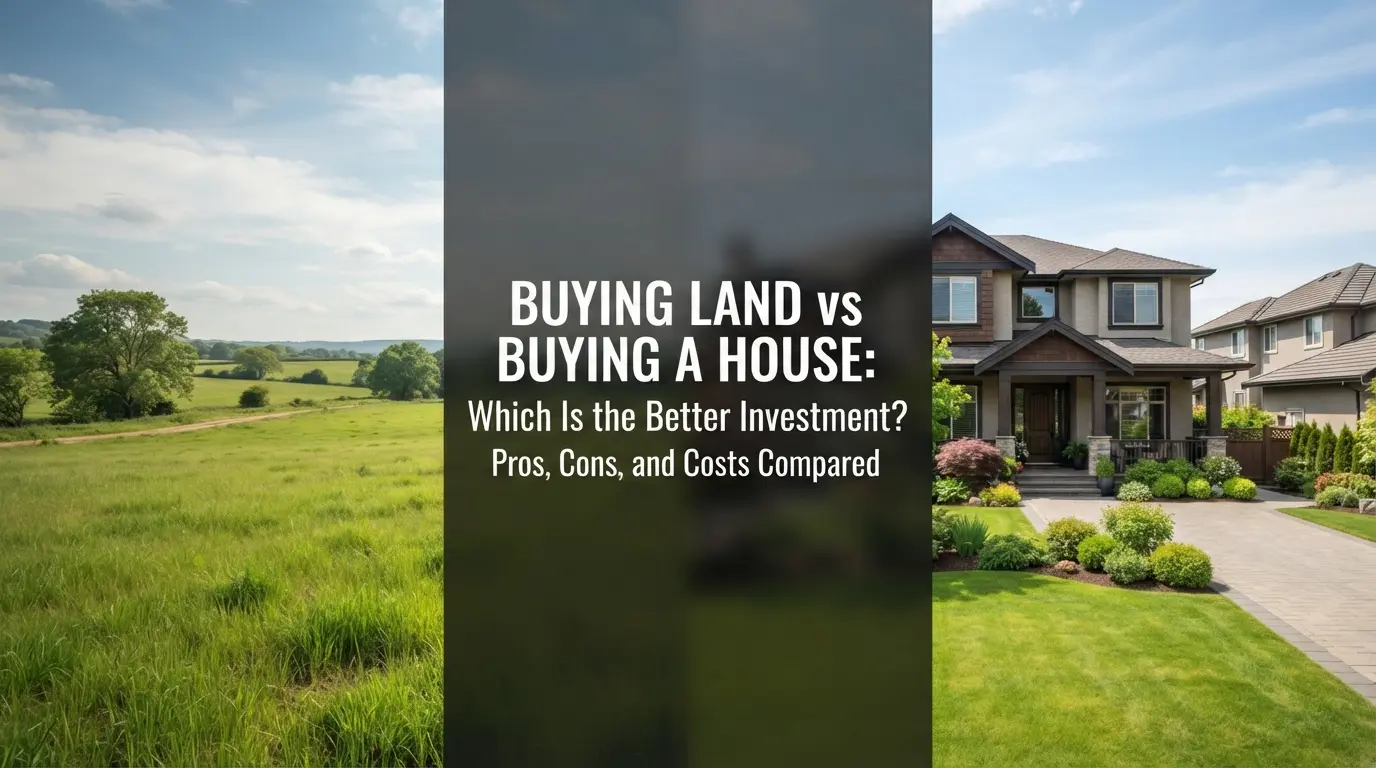
You have saved enough to buy property, but now you are stuck on a question that trips up most first-time buyers in Nigeria: do you buy land and build exactly what you want, or do you buy a house and move in without the headache of construction?
The answer depends on your timeline, budget, and tolerance for risk. This guide compares the costs, financing options, pros, cons, and due diligence steps for each path so you can decide which one fits your situation.
Buying land vs buying a house in Nigeria at a glance
For most people, buying an existing house is the more practical choice. You can move in within weeks, financing is simpler, and the total cost is easier to predict. Buying land, on the other hand, makes sense if you want a fully custom build and have both the patience and budget to see construction through.
Here is how the two options compare:
| Factor | Buying Land | Buying a House |
|---|---|---|
| Move-in timeline | Months to years after construction | 30–45 days after closing |
| Financing | Higher down payments, stricter terms | Standard mortgages with lower deposits |
| Total cost | Purchase price plus construction, permits, utilities | Usually includes structure and utilities |
| Customization | Full control over design | Limited to existing layout |
| Maintenance | Low while undeveloped | Ongoing repairs, especially for older homes |
The rest of this guide breaks down each factor so you can see which option fits your situation.
Cost of buying land vs buying a house in naira
Cost is usually the first thing buyers want to know. But "cost" means something different depending on what you are buying. For land, the price covers only the plot. For a house, the price typically includes the structure, connected utilities, and sometimes basic furnishing.
Cost of buying land in Lagos, Abuja, and Enugu
Land prices vary based on a few key factors:
- Location: Prime areas like Lekki Phase 1 or Maitama cost more than emerging suburbs like Ibeju-Lekki or Lugbe.
- Plot size: A standard 500 sqm residential plot costs less than a 1,000 sqm parcel in the same area.
- Title type: Land with a Certificate of Occupancy (C of O) is priced higher than plots with a Deed of Assignment or excision still in progress.
- Accessibility: Plots on tarred roads attract premiums over interior plots that require right-of-way access.
Keep in mind that the purchase price alone does not reflect total investment. You still have to budget for construction, permits, and utility hookups before the land becomes livable.
Cost of buying a house in Lagos, Abuja, and Enugu
House prices depend on different variables:
- Property type: Detached houses cost more than semi-detached units, terraces, or apartments.
- Age and condition: New builds carry a premium, while older homes may require renovation.
- Finishing level: Premium finishes like imported tiles or smart home systems push prices up.
- Estate or standalone: Gated estates with security and shared amenities often command higher prices.
Because a house price usually includes the structure, electricity, water, and landscaping, the upfront cost is more predictable than land plus construction.
Cost of building a house on land you already own
If you buy land, the purchase price is only the beginning. You will also pay for:
- Construction materials and labour
- Architectural and engineering drawings
- Building permits and regulatory approvals
- Utility hookups (electricity, water, sewage)
- Compound finishing (fencing, gate, interlocking pavement)
When you add up all of the above, total outlay often exceeds the price of a comparable existing house in the same location. Many first-time buyers underestimate this gap.
Pros and cons of buying land
Advantages of buying land
- Total customization: You design the layout, floor plan, and finishes from scratch.
- Lower holding maintenance: Raw land requires no urgent structural repairs while you plan.
- Long-term appreciation: Land in expanding areas can grow in value as a finite resource.
- Flexibility to build in phases: You can develop gradually as funds allow, starting with a fence and foundation, then adding the structure later.
Drawbacks of buying land
- Larger down payments: Lenders treat land as higher risk and often require 30–50% upfront.
- No immediate use: You cannot move in or rent out until construction completes.
- Construction stress: Permitting delays, contractor disputes, and material price swings are common.
- Utility uncertainty: Connecting electricity and water may take months or years depending on location.
Pros and cons of buying a house
Advantages of buying a house
- Immediate move-in: You can occupy or rent out within weeks of closing.
- Simpler financing: Traditional mortgages for existing homes carry lower interest rates and smaller down payments.
- Lower total cost: The purchase price usually includes structure, utilities, and landscaping already in place.
- Established neighbourhood: Roads, drainage, security infrastructure, and community amenities already exist.
Drawbacks of buying a house
- Limited customization: You inherit the previous owner's layout and design choices.
- Ongoing repairs: Older homes may require roof, plumbing, or electrical work soon after purchase.
- Competitive bidding: Desirable houses in prime areas attract multiple offers, which can push prices above asking.
Which is the better investment for long-term value
The answer depends on what you are trying to achieve. Land tends to appreciate as a finite resource, especially in expanding corridors like Ibeju-Lekki, Centenary City Abuja, or the Enugu-Onitsha expressway axis. However, undeveloped land generates no income while you hold it.
A house can produce rental income immediately and may appreciate if well-maintained. The structure itself depreciates over time, though the underlying land gains value. So if you are a patient investor focused on capital gains, land often wins. If you want income plus moderate appreciation, a house is usually the better fit.
Tip: Realinkr's neighbourhood guides cover growth corridors across Lagos, Abuja, Enugu, and other cities, helping you identify areas with strong appreciation potential before you commit.
Land loans vs mortgages in Nigeria
Many first-time buyers assume the same loan works for both land and houses. It does not.
A land loan is specifically for purchasing undeveloped or raw land. Lenders view land as higher risk because it cannot be occupied or rented immediately. A mortgage, by contrast, is secured by a completed residential property. Because the house can be occupied or sold quickly, lenders offer more favourable terms.
| Factor | Land Loan | Mortgage |
|---|---|---|
| Typical down payment | 30–50% | 10–20% |
| Interest rate | Higher | Lower |
| Loan tenure | 3–10 years | 10–20 years |
| Lender risk perception | High | Moderate |
Construction loans exist to bridge the gap between land purchase and building completion. They come with their own requirements, including approved building plans and disbursement tied to construction milestones.
Due diligence for land vs a house
Verification steps differ because the risks differ. Land fraud (Omo-Onile issues, forged titles) is common in Nigeria, while houses carry structural and legal risks.
Land title verification and LASRERA checks
Before paying for land, confirm the following:
- Certificate of Occupancy (C of O): Verify it is genuine and registered at the Land Registry.
- Governor's Consent: Required for any subsequent transfer of C of O land.
- Survey plan: Verify boundaries match what the seller shows on ground.
- Excision status: For land in government acquisition areas, confirm the excision gazette.
- LASRERA agent verification: LASRERA (Lagos State Real Estate Regulatory Authority) registers legitimate estate agents in Lagos. Confirm your agent is registered before transacting.
Home inspections and structural checks
For houses, inspection covers different ground:
- Foundation and walls: Look for cracks, dampness, or settling.
- Roof: Check for leaks, sagging, or rusted sheets.
- Plumbing: Test water pressure, drainage, and septic tank condition.
- Electrical: Assess wiring age, panel capacity, and earthing.
- Title search: Confirm the seller has legal right to sell and no encumbrances exist.
Hiring a qualified surveyor and property lawyer protects you from hidden defects and disputes.
Access, utilities, and infrastructure considerations
Raw land often lacks what a house includes by default. Before buying land, consider:
- Road access: Some plots sit behind others and require right-of-way agreements.
- Electricity: Connecting to the grid may require buying a transformer or joining a community connection effort.
- Water: Borehole drilling or public water extension adds cost and time.
- Drainage and sewage: Poorly drained land floods during rainy season, and septic systems have to meet local codes.
Houses in established estates typically have all of the above sorted. When comparing total cost, factor in infrastructure.
How to decide between buying land and buying a house
1. Define your investment timeline
If you want to move in or start earning rent within months, a house is the practical choice. If you can wait several years for construction and development, land offers customization and potential appreciation.
2. Match the asset to your budget and financing
Calculate total cost. For land, add estimated construction, permits, and utilities to the purchase price. Compare that sum to the price of a ready house in the same location. Also consider available financing: mortgages for houses are more accessible than land or construction loans.
3. Verify location growth and infrastructure
Research government infrastructure plans (roads, rail, industrial zones) that may boost land values. For houses, check whether the neighbourhood is mature or still developing.
4. Confirm title, documentation, and regulatory approval
Both options require legal due diligence, but the specific documents differ. Engage a property lawyer before signing any agreement.
Start your search with verified listings on Realinkr
Realinkr's discovery platform lets you search verified land and house listings across Nigerian cities, connect with LASRERA-registered agents, book viewings, and close deals with less friction. Whether you are leaning toward land or a house, the neighbourhood guides help you identify high-growth areas before you commit.
Frequently asked questions about buying land vs buying a house
Is buying land harder than buying a house in Nigeria?
Land transactions involve more title verification steps and higher financing hurdles, making them more complex than buying an existing house with clear documentation.
What does the 3-3-3 rule mean for property buyers?
The 3-3-3 rule suggests a buyer plan to stay in a property for at least three years, keep housing costs below one-third of income, and have three months of expenses saved before purchasing.
Do you pay taxes when you buy a plot of land in Nigeria?
Land transactions attract stamp duty, capital gains tax (paid by the seller but sometimes negotiated), and registration fees at the Land Registry.
Can a diaspora buyer purchase land or a house in Nigeria remotely?
Yes. Diaspora buyers can purchase remotely by granting power of attorney to a trusted representative and working with verified agents and lawyers who handle viewings, documentation, and registration on their behalf.
How long does land take to appreciate in Lagos or Abuja?
Appreciation depends on location, infrastructure development, and market demand. Land in high-growth corridors may see noticeable gains within a few years, while land in slower areas may take longer.